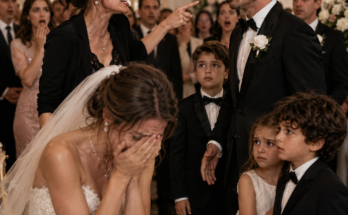
I stood across from Arthur, my soon-to-be husband, holding his trembling hands.
At eighty-one, his silver hair and gentle smile made him look every bit the distinguished gentleman everyone in town admired.
At thirty-six, I knew exactly what people thought when they saw us together.
Gold digger.
They whispered it in grocery stores.
They posted it online.
Some even had the nerve to say it loud enough for me to hear.
If only they knew.
Three years earlier, I’d met Arthur at the public library where I worked. He came every Thursday afternoon to borrow history books and always returned them with tiny handwritten notes tucked inside.
“Wonderful chapter on Lincoln.”
“The ending made me cry.”
“You should read page 214.”
Eventually, those notes turned into conversations.
Conversations became coffee.
Coffee became friendship.
Friendship became the kind of love I never expected.
Arthur never tried to impress me with his wealth.
In fact, I didn’t even know he had any.
He drove a twelve-year-old sedan, wore the same brown coat every winter, and insisted coupons were “little gifts from the universe.”
Months later, I learned he owned several companies and had quietly donated millions to children’s hospitals.
When he proposed, I said yes because of the way he made me laugh.
Because he remembered my mother’s birthday after hearing it only once.
Because he never let me carry grocery bags.
Because he looked at me as though I were the greatest miracle he’d ever seen.
Still…
His children weren’t convinced.
His eldest son refused to attend the engagement party.
His daughter hired a private investigator.
His youngest grandson asked me outright if I planned to “cash out.”
Arthur ignored every insult.
“They’ll understand someday,” he’d always say.
I wasn’t so sure.
The wedding day finally arrived.
Nearly two hundred guests filled the chapel.
Half were my friends.
Half were his family.
The tension between those halves could’ve snapped steel.
Our officiant smiled warmly.
“We’re gathered here today…”
Everything went perfectly until it came time for our vows.
Arthur cleared his throat.
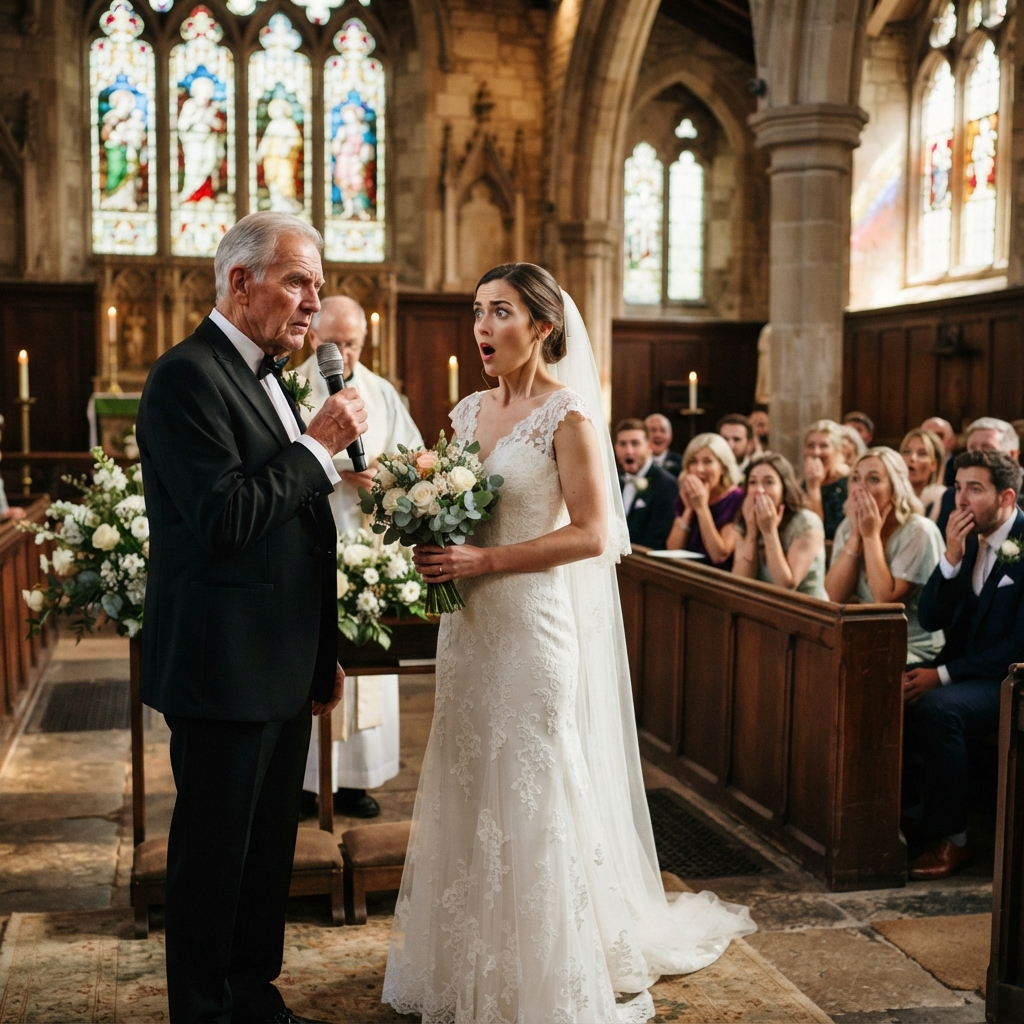
Instead of repeating the officiant’s words, he slowly reached for the microphone.
His children exchanged puzzled looks.
He smiled at me.
Then turned toward the guests.
“My bride,” he said softly, “doesn’t know the most important thing about me.”
Every face froze.
Even I blinked.
What was he talking about?
Had he been hiding another family?
A terminal illness?
Massive debt?
My stomach tightened.
Arthur squeezed my hand.
“I’ve kept this secret because I was ashamed.”
The room became impossibly quiet.
“I’ve allowed everyone—including the people I love most—to believe I built my fortune alone.”
His eyes filled with tears.
“But I didn’t.”
Confused murmurs spread through the pews.
Arthur continued.
“When I was twenty-six years old, I made a terrible mistake.”
His daughter covered her mouth.
“I invested every dollar my wife and I had into a business that failed.”
“I lost our house.”
“Our savings.”
“Our future.”
He swallowed hard.
“My wife, Eleanor, worked three jobs for years while I rebuilt everything.”
He paused.
“Every newspaper called me a self-made man.”
“They were wrong.”
“Eleanor built me.”
Many guests quietly wiped away tears.
Arthur looked toward a woman sitting in the third row.
An elderly lady with kind eyes stood slowly.
I’d seen her once before but never knew who she was.
“This,” Arthur said, “is Margaret.”
“My late wife’s younger sister.”
Margaret smiled sadly.
“Twenty years ago,” Arthur continued, “after Eleanor died, Margaret gave me something.”
She walked toward us carrying a worn leather journal.
Arthur accepted it carefully.
“Eleanor kept this diary for nearly forty years.”
He turned to me.
“I’ve never let anyone read it.”
He placed it gently into my hands.
“But last month…”
“I realized who deserved it.”
I stared at him in confusion.
“Me?”
He nodded.
“The last page.”
With trembling fingers, I opened the journal.
The ink had faded with time.
But the handwriting remained beautiful.
It read:
Arthur…
If you’re reading this, I’m already gone.
I know you’ll feel guilty for surviving me.
Don’t.
Love again.
Laugh again.
Find someone whose heart is kind.
Don’t choose someone because the world approves.
Choose the woman who reaches for your hand when you’re frightened.
She’ll be my gift to you.
My vision blurred with tears.
Arthur gently smiled.
“I read those words every year.”
He took a deep breath.
“And the first time Emily reached for my hand was in the hospital waiting room after my heart surgery.”
“I knew.”
The entire chapel had become silent again.
Arthur looked toward his children.
“I also have another confession.”
His voice grew firmer.
“I’ve watched my family judge Emily for three years.”
“I allowed it because I hoped you’d eventually see what I see.”
His oldest son lowered his head.
“You failed.”
The words weren’t angry.
They were heartbreaking.
“I’ve already updated my will.”
Gasps echoed around the room.
His children stiffened.
“I am leaving plenty to every member of my family.”
Relief briefly crossed several faces.
“But the majority of my estate…”
Everyone looked at me.
“…is going to the Eleanor Hope Foundation.”
I frowned.
“The what?”
Arthur smiled.
“It doesn’t exist.”
“Yet.”
He reached into his jacket and removed another envelope.
“It’s a charitable foundation in Eleanor’s name.”
He handed it to me.
“And my bride will lead it.”
I stared at him.
“I don’t…”
“You’ve spent your entire career helping children learn to read,” he interrupted gently.
“You’ve organized book drives.”
“You’ve paid for school supplies without telling anyone.”
“You already know how to lead.”
My knees nearly gave out.
“You never wanted my money,” Arthur whispered.
“So I’m not giving it to you.”
“I’m giving you a purpose.”
Tears streamed freely down my face.
The guests erupted into applause.
Even Arthur’s daughter was crying.
After the ceremony, she approached me quietly.
“I owe you an apology.”
“So do I,” her brother admitted.
“We thought you were after his fortune.”
I smiled weakly.
“I was after your father.”
Arthur chuckled.
“I told you they’d understand someday.”
He was right.
Over the next four years, the Eleanor Hope Foundation built libraries in underserved communities, funded literacy programs, and provided scholarships for aspiring teachers. Arthur insisted on attending every ribbon-cutting ceremony he could, greeting children with the same warmth he’d once shown me at the library.
When he passed away peacefully at eighty-five, the newspapers celebrated his business achievements. But the headline I clipped and kept in a frame read:
“Philanthropist Remembered for Giving Thousands of Children the Gift of Reading.”
They had finally understood the most important thing about him.
It was never his wealth.
It was what he chose to do with it—and the people he trusted to carry that kindness forward.