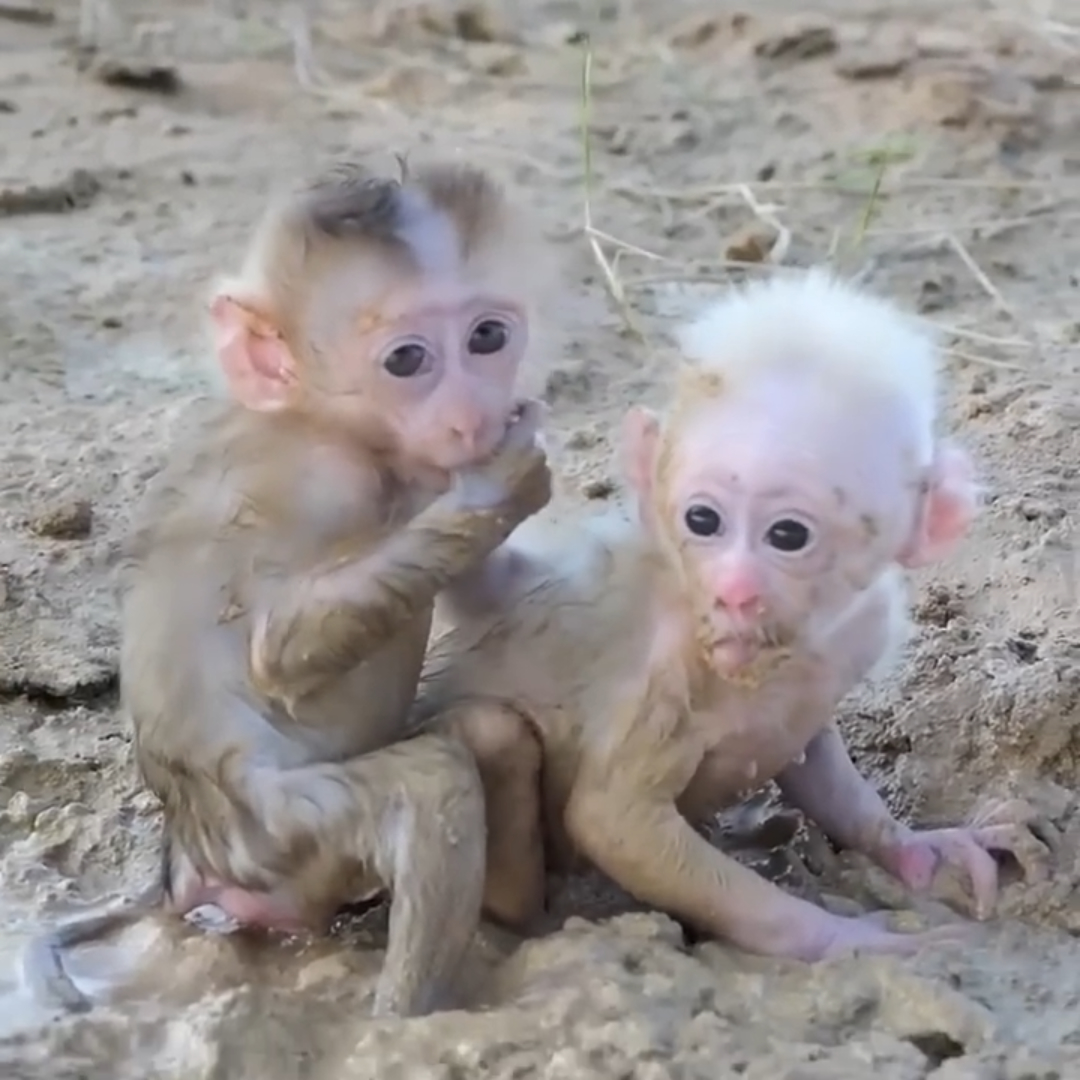
The morning sun had barely begun to warm the dusty ground when two tiny monkeys found themselves alone together.
They were still very young—so young that the world seemed enormous around them. Their little hands were clumsy, their legs weak, and every unfamiliar sound made them stop and look around.
The smaller monkey sat close to the other, carefully holding onto its companion as if afraid to let go. The second baby monkey watched quietly, bringing one tiny hand toward its mouth. Neither seemed to understand what had happened or where the adults were.
But they understood one thing: they were not alone.
The older-looking baby slowly moved closer. It gently touched the other’s arm, almost as if saying, “Stay with me.”
The little one leaned against its friend.
For a while, they simply sat there on the dry earth.
Birds called from somewhere beyond the trees. Leaves rustled in the distance. The wind passed softly over the ground. Around them, life continued as usual—but for these two babies, the world had suddenly become frighteningly quiet.
Then the smaller monkey noticed something and became nervous. It looked around, searching for a familiar face.
Nothing.
The other monkey reached out and held its hand.
That tiny gesture seemed to bring comfort.
They stayed together.
When one became tired, the other remained beside it. When one became frightened, the other moved closer. They had no words to explain their fear, no way to understand the future, and no way to know when help would come.
Yet somehow, they gave each other courage.
As the sun climbed higher, the two babies continued sitting side by side, their little bodies touching.
They were only infants, but in that moment they showed something much bigger than themselves:
Sometimes survival begins with simply refusing to leave someone behind.
And while the forest stretched endlessly around them, two tiny hands remained together—quietly promising that, for as long as they could, neither would face the world alone.