The first phone call came less than twenty-four hours after my daughter’s wedding.
I almost didn’t answer.
It was just after six in the morning, and I assumed Emily was calling to tell me about the honeymoon flight or to laugh about something that had gone wrong at the reception.
Instead, the voice on the other end belonged to my new son-in-law.
“Mr. Carter,” Daniel said quietly. “Can you come over? Please.”
His voice didn’t sound angry.
It sounded defeated.
My stomach tightened.
“Is Emily okay?”
There was a long silence.
“I… I don’t know anymore.”
Those words chilled me more than shouting ever could.
Within thirty minutes I was driving toward the Victorian home Daniel’s grandparents had owned for nearly fifty years. The reception had ended there the night before with music, laughter, and hundreds of smiling photographs.
Now police cars lined the curb.
Neighbors stood in clusters, whispering.
An ambulance sat with its lights off.
Emily was standing on the front porch, wrapped in a blanket despite the warm summer morning.
Her mascara had run down her cheeks.
She looked like she hadn’t stopped crying.
The moment she saw me, she ran into my arms.
“Dad…”
“I didn’t do it.”
I pulled back just enough to look into her eyes.
“What happened?”
Before she could answer, a sharp voice interrupted us.
“She stole it.”
Daniel’s aunt, Margaret, marched down the porch steps with two detectives behind her.
“The necklace is gone,” she announced loudly, making sure every neighbor could hear. “Our grandmother’s diamond necklace disappeared sometime after the reception, and your daughter was the last person seen near the upstairs bedroom.”
Emily’s face turned white.
“I wasn’t stealing anything.”
Margaret folded her arms.
“Then explain why you disappeared for almost twenty minutes.”
Emily opened her mouth, then closed it again.
She looked terrified.
“I… I can’t.”
Margaret gave a bitter laugh.
“Convenient.”
Daniel stepped between them.
“Enough.”
“No,” Margaret snapped. “This family deserves answers.”
One of the detectives spoke gently.
“Miss Carter, if there’s an explanation, now would be a good time.”
Emily looked at me.
Then at Daniel.
Finally she whispered, “I promised someone I wouldn’t tell.”
My heart sank.
Keeping a secret now made her look guilty.
The detectives searched the house from top to bottom.
They checked luggage.
Drawers.
Wedding gifts.
Cars.
Nothing.
The necklace, worth nearly half a million dollars according to Margaret, had simply vanished.
By afternoon, rumors spread across town.
The bride had robbed her new family.
Some claimed she’d planned it all along.
Others insisted she’d married Daniel for money.
Every cruel version of the story traveled faster than the truth ever could.
Emily and Daniel canceled their honeymoon.
She barely left her room for the next three days.
On the fourth evening, I found her sitting on the back porch of my house, staring into the woods.
“They all hate me,” she whispered.
“I don’t.”
“You have to.”
“I know my daughter.”
Tears rolled down her cheeks.
“I kept my promise.”
“What promise?”
She shook her head.
“I can’t tell you.”
That frightened me more than anything else.
Emily had never lied to me—not as a child, not as a teenager, not as an adult.
If she was refusing to explain, someone had convinced her that silence mattered more than her own reputation.
The breakthrough came from the most unexpected place.
Daniel’s grandfather, Harold Whitmore, passed away six days after the wedding.
He had been eighty-seven and in poor health for years.
The stress of the accusations seemed to drain whatever strength he had left.
After the funeral, Daniel called me again.
“Grandpa left you something.”
“Me?”
“He specifically named you.”
Confused, I met Daniel at the old family house.
Most relatives refused to look at me.
Margaret turned away as though my presence offended her.
Daniel led me upstairs to Harold’s study.
The room smelled of cedar, old books, and pipe tobacco.
On the desk sat a small brass key taped to an envelope.
Across the front, in shaky handwriting, were five words:
For Emily’s father. Open alone.
Inside was a single note.
The truth is behind the library.
At first I thought grief had clouded Harold’s mind.
Then I noticed faint scratches beneath one bookshelf.
I pressed against the side.
Nothing.
I tried pulling one of the carved wooden columns.
A soft click echoed through the room.
The entire bookshelf shifted outward.
Behind it stood a narrow steel door.
Hidden.
Locked.
The brass key fit perfectly.
Inside was a cramped room no larger than a closet.
Metal shelves lined one wall.
A desk occupied the other.
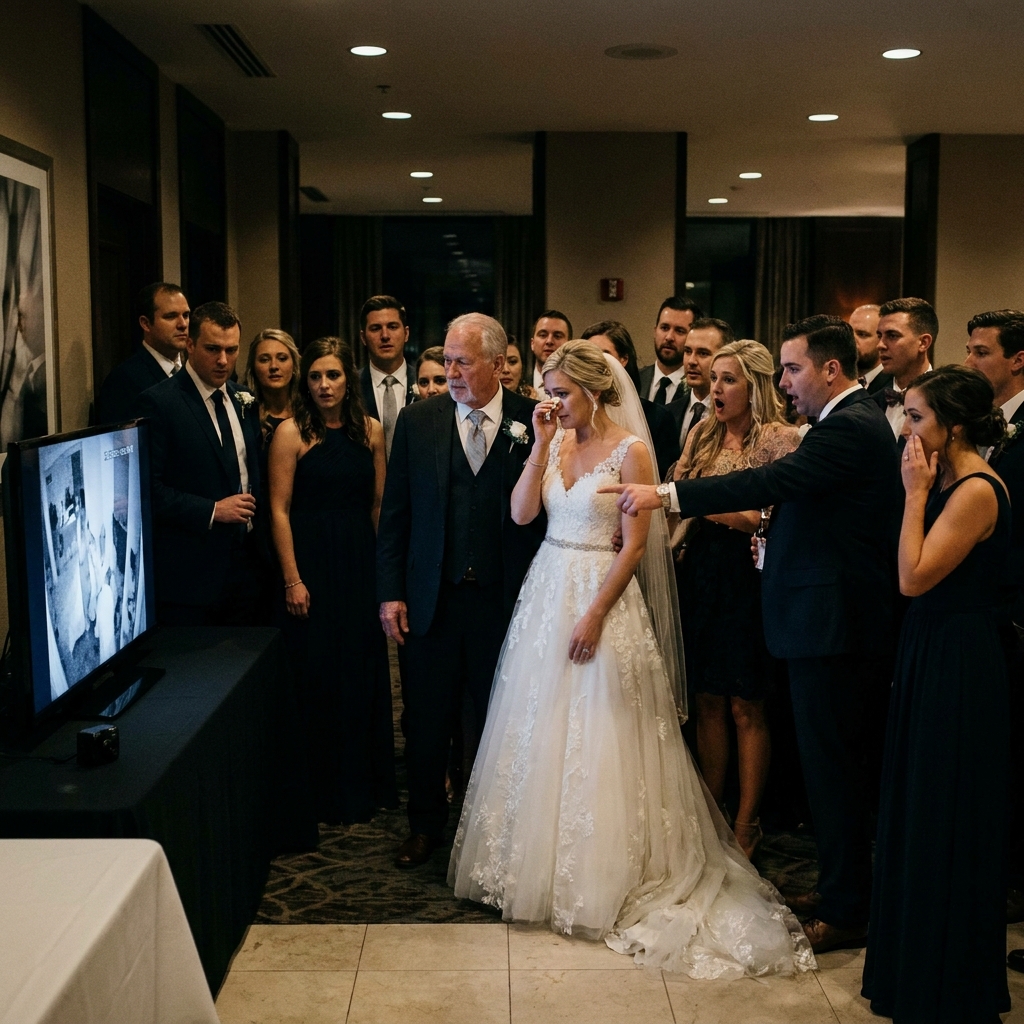
And mounted in the corner was a small security monitor connected to an aging digital recorder.
A label was taped beneath it.
Archive Cameras.
I inserted the final memory card.
Static filled the screen.
Then the wedding reception appeared.
The timestamp matched the exact period when Emily had supposedly disappeared.
I watched her leave the dance floor and climb the staircase.
Moments later, Harold followed her.
Neither looked upset.
He unlocked his study.
They disappeared inside together.
Exactly eighteen minutes later, Emily emerged alone, wiping tears from her eyes.
Harold followed slowly with the help of his cane.
She hadn’t entered the bedroom where the necklace had been kept.
Not even once.
I fast-forwarded.
Ten minutes later another figure appeared.
Margaret.
She glanced over both shoulders before quietly slipping into her mother’s bedroom.
She carried nothing in.
She left carrying a velvet jewelry box.
My pulse quickened.
Instead of sounding an alarm, Margaret walked directly into Harold’s study.
She believed no one was watching.
She crossed to a grandfather clock.
Reached inside.
Removed a wooden panel.
And hid the jewelry box.
Then she smiled.
Not nervously.
Confidently.
As though she already knew exactly who would be blamed.
I replayed the footage three times.
Each viewing made one fact undeniable.
Emily had been innocent from the beginning.
Margaret had staged the theft.
The following morning, with detectives present, the hidden compartment in the grandfather clock was opened.
The diamond necklace lay exactly where the recording showed it.
When confronted with the video, Margaret’s composure crumbled.
Between sobs, she admitted she had orchestrated the entire accusation. Buried in debt after years of failed investments, she intended to “discover” the necklace weeks later, claim it had been misplaced, and quietly sell it through a broker. By directing suspicion toward the newest member of the family, she believed no one would ever question her.
Then the detectives asked the question that had haunted me from the start.
“Why couldn’t Emily explain where she really was?”
Daniel handed them another envelope Harold had left behind.
Inside was a letter.
Harold wrote that he had invited Emily to his study during the reception because he had recently been diagnosed with a terminal illness. He wanted to give her a wedding gift in private: a collection of handwritten letters he had written to his late wife over sixty years of marriage. He asked Emily not to tell anyone until after his death because he wanted those letters to become a surprise family keepsake.
Emily had kept that promise, even when it meant enduring public humiliation, suspicion, and the collapse of her reputation.
She had chosen to protect an old man’s final wish rather than save herself.
The room fell silent as Daniel finished reading.
Margaret stared at the floor.
One by one, relatives who had shunned Emily began to cry.
Several apologized.
Some admitted they had believed the rumors without asking a single question.
Emily accepted their apologies politely, but trust, once broken, was not so easily repaired.
Months later, Daniel and Emily renewed their vows in a small ceremony by a lakeside chapel. There were no extravagant decorations, no priceless heirlooms, and no gossiping crowds—only the people who had stood by them when it mattered.
Before the ceremony began, Daniel placed Harold’s bundle of love letters into Emily’s hands.
“They were his real wedding gift,” he said.
Emily smiled through tears.
“Then we’ll keep them where everyone can read them.”
The letters were eventually published as a family memoir, reminding future generations that love is measured by loyalty, not appearances.
As for the hidden camera, it was removed from the old study after the investigation ended. It had spent years quietly recording ordinary days, never intended to expose a crime.
Yet when the moment came, that forgotten lens preserved the one thing every accusation had nearly destroyed:
The truth.