The Jacket He Wouldn’t Take Off
When I pulled into my father’s driveway after nearly eight months away, I expected laughter, coffee on the porch, and one of his terrible jokes about how I’d finally remembered where he lived.
Instead, the house felt strangely quiet.
The curtains were closed even though it was the middle of the afternoon. The flower beds my father once cared for so proudly were overgrown with weeds, and the mailbox leaned awkwardly toward the road.
I knocked.
After several long moments, the door opened just a crack.
“There you are,” my father said with a tired smile.
He looked thinner.
Much thinner.
His silver hair hadn’t been combed, and his hands trembled as he unlocked the storm door.
“Dad…”
He hugged me briefly before quickly stepping back.
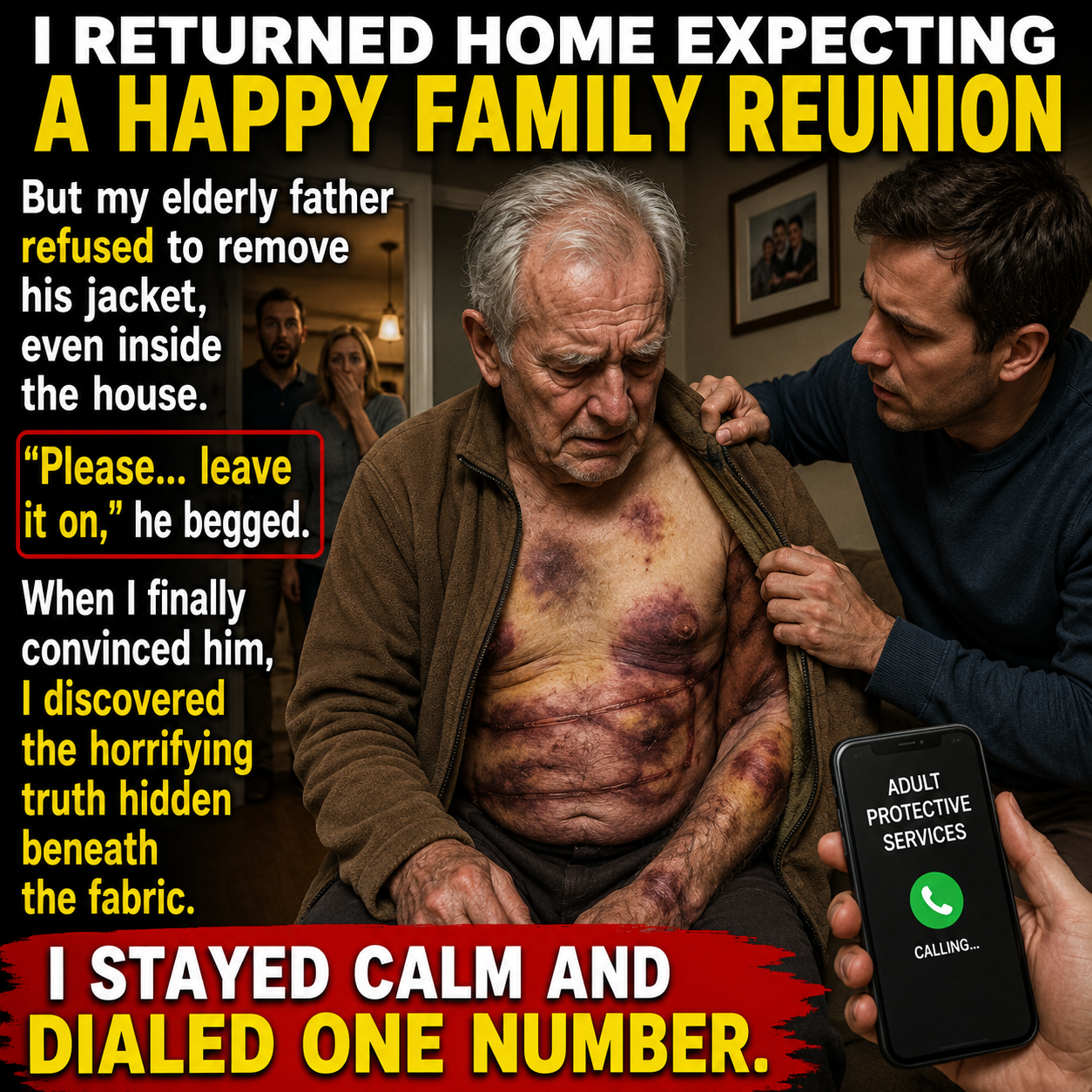
Despite the summer heat, he was wearing a thick brown jacket zipped all the way to his neck.
“Aren’t you roasting?” I asked.
“I’m fine.”
His answer came too quickly.
Inside, the house was spotless—almost unnaturally so.
Everything was perfectly arranged, as though someone had cleaned in a hurry before I arrived.
“Where’s Mark?” I asked, referring to my younger brother.
“Work,” Dad replied.
“And Emily?”
“Shopping.”
They had moved in six months earlier after insisting Dad shouldn’t live alone anymore.
At first, I’d been relieved.
Now…
Something felt wrong.
Dad insisted on making lunch.
As he reached for a plate, I noticed him wince.
“You okay?”
“Just arthritis.”
But arthritis didn’t explain why he kept his right arm pressed tightly against his body.
It didn’t explain why he avoided eye contact.
And it certainly didn’t explain why he jumped every time a car drove past the house.
That evening, I found him sitting alone on the back porch.
The temperature was still over ninety degrees.
He hadn’t taken the jacket off once.
“Dad,” I said gently.
“You’re going to get heatstroke.”
“I’m alright.”
“You don’t have to pretend around me.”
He stared into the yard.
After nearly a minute, he whispered,
“They’ll be upset.”
“Who?”
No answer.
“They don’t like it when I make trouble.”
A chill ran through me.
The next morning I found him struggling to button the jacket.
His fingers shook so badly he couldn’t manage it.
“Let me help.”
“No.”
His voice cracked.
“Please…”
He backed away.
“Leave it on.”
“Dad.”
His eyes filled with tears.
“Please…”
The fear on his face wasn’t embarrassment.
It was terror.
I stepped closer.
“I’m your son.”
“No one’s going to hurt you.”
He began crying silently.
Finally…
He nodded.
With careful hands, I slowly unzipped the jacket.
Then gently pulled it from his shoulders.
I couldn’t breathe.
Dark purple bruises covered both arms.
Old yellow bruises mixed with fresh ones.
Deep red marks circled his wrists.
There were healing cuts across his back.
Some injuries were days old.
Others looked weeks old.
None looked accidental.
I had never felt my stomach drop so fast.
“Dad…”
He couldn’t look at me.
“They said I was becoming difficult.”
His voice barely rose above a whisper.
“They tie my hands sometimes.”
I froze.
“What?”
“So I won’t wander.”
“They said the doctor told them to.”
“No doctor would ever say that.”
He nodded sadly.
“I know now.”
Tears rolled down his face.
“If I spilled food…”
“They’d yell.”
“If I forgot medicine…”
“They’d lock me in my room.”
“If I argued…”
He rubbed one bruised wrist.
“The rope came out.”
Every sentence hurt more than the last.
I wanted to explode.
I wanted to confront my brother.
I wanted answers.
Instead…
I remembered something a detective friend once told me.
“If someone is being abused, don’t warn the abuser first.”
So I stayed calm.
I helped Dad put on a clean shirt.
Made him tea.
Then quietly walked into the kitchen.
I took out my phone.
And dialed Adult Protective Services.
Then I called the sheriff’s office.
Within forty minutes, investigators arrived alongside deputies trained to handle elder abuse cases.
When Mark and Emily pulled into the driveway, they found three patrol cars parked outside.
My brother’s smile disappeared instantly.
“What’s going on?”
One deputy stepped forward.
“We need to ask you both some questions.”
Emily looked toward the house.
“Dad?”
“He is safe,” the investigator replied.
“That’s all you need to know right now.”
They exchanged nervous glances.
Inside, investigators photographed every injury.
Medical personnel documented bruises, abrasions, and signs of restraint.
They examined the bedroom.
Hidden inside a closet they found soft restraints, several medications prescribed to someone else, and a notebook.
The notebook contained daily entries.
“Didn’t listen today.”
“Refused dinner.”
“Used restraints for an hour.”
“Needs stricter discipline.”
Each page became another piece of evidence.
Neighbors began speaking with investigators.
One remembered hearing shouting almost every night.
Another recalled seeing my father standing outside alone in freezing weather wearing only that same jacket.
A delivery driver reported hearing someone crying through an open window weeks earlier.
The pattern became impossible to ignore.
Dad was taken to the hospital.
Doctors confirmed multiple injuries in different stages of healing.
Some bruises matched restraint marks.
Others suggested repeated rough handling.
The medical team also found he was dehydrated and undernourished.
He should have been receiving regular care.
Instead, he had been living in fear.
Over the following weeks, social workers helped him move into a rehabilitation center while the investigation continued.
For the first time in months, he slept through the night without waking in panic.
One afternoon I visited him.
He was sitting by a window watching birds gather around a feeder.
No jacket.
Just a light blue sweater.
“You know,” he said with a faint smile, “I forgot what fresh air feels like.”
I sat beside him.
“I’m sorry I wasn’t here sooner.”
He squeezed my hand.
“You came when I needed you.”
Sometimes healing doesn’t begin with shouting.
Sometimes it begins with believing someone who is too frightened to speak.
And sometimes, the most powerful thing you can do…
…is make one phone call.