The invitation arrived three weeks before my father’s seventy-fifth birthday.
A simple white card.
Gold lettering.
Elegant handwriting.
“Please join us for a special family dinner celebrating Grandpa’s 75th birthday.”
My children were excited.
They always loved visiting their grandfather.
My son, Lucas, spent the entire week before the dinner drawing a picture for him. My daughter, Emma, carefully picked out a small wooden bird she painted herself.
“Grandpa likes things made by hand,” she said.
I smiled.
“He does.”
What I didn’t know was that by the end of that night, my children would learn something no child should ever have to learn.
That sometimes the people sitting closest to you can still make you feel like a stranger.
My father, Robert Mitchell, had always been a complicated man.
He was hardworking.
Successful.
Respected by everyone in town.
He built a construction company from nothing and spent forty years turning it into one of the biggest businesses in the area.
People admired him.
They called him a self-made man.
But at home, he was different.
He believed love was something you earned.
Praise was rare.
Hugs were even rarer.
When I was young, I used to think my father simply didn’t know how to show affection.
After my mother passed away, I convinced myself he would become softer.
He didn’t.
But he tried.
At least, I thought he tried.
My older brother, Daniel, was always my father’s favorite.
Everyone knew it.
Daniel was confident.
Successful.
Exactly the kind of son my father wanted.
He joined the family business after college and eventually became the company’s vice president.
I took a different path.
I became a teacher.
My father never said he was disappointed, but I could feel it.
“Teaching is a noble job,” he once told me.
The way he said it made it sound like he was saying:
“It’s nice that you have a hobby.”
After I married Michael and had Lucas and Emma, my relationship with my father became easier.
Not perfect.
But better.
The children softened him.
My father, the man who rarely smiled, became Grandpa.
And Grandpa was different.
He played board games.
He told silly stories.
He kept candy hidden in his desk drawer.
My children saw the side of him I had spent years waiting for.
The birthday dinner was held at my brother Daniel’s house.
It was a beautiful place.
Huge backyard.
Swimming pool.
Perfect landscaping.
Everything my father admired.
When we arrived, my children ran inside.
“Grandpa!”
My father turned around and smiled.
“There are my favorite people.”
Lucas hugged him.
Emma gave him her painted bird.
“I made this for your office.”
My father looked at it carefully.
“It’s beautiful.”
I watched his face.
For once, he looked genuinely happy.
Maybe things really had changed.
Maybe families could heal.
I wanted to believe that.
The guests arrived.
Relatives.
Business friends.
Neighbors.
Everyone praised my father.
“Seventy-five years young!”
“You built an empire!”
“You must be so proud!”
My father smiled politely.
Dinner began at seven.
The table was full.
There were expensive dishes everywhere.
Roasted chicken.
Steak.
Fresh seafood.
Multiple desserts.
My children sat beside me, excited.
But as plates were passed around, something strange happened.
Everyone received food.
Except Lucas and Emma.
At first, I thought it was accidental.
The serving dishes reached the end of the table empty.
“It’s okay,” I whispered to them.
“I’ll get you something.”
I stood up.
Before I could move, Daniel’s wife, Rachel, spoke.
“Oh, I thought the kids were eating before we arrived.”
I looked at her.
“What?”
She smiled.
“I mean, children don’t usually need a full meal at these events.”
I stared at her.
My daughter looked down at her empty plate.
My son’s smile disappeared.
“Rachel,” I said calmly, “they haven’t eaten dinner.”
She shrugged.
“There are snacks in the kitchen.”
I looked around the table.
Everyone had heard.
Nobody said anything.
Nobody moved.
That silence hurt more than the empty plates.
I went to the kitchen myself.
I opened the refrigerator.
Nothing prepared for my children.
No food.
No snacks.
Nothing.
Then I saw it.
A tray of sandwiches.
Covered.
Untouched.
I brought it back.
My father watched me.
“What’s going on?”
I looked at him.
“Your grandchildren don’t have dinner.”
His expression changed.
“What?”
“They’ve been sitting here with empty plates.”
The room became quiet.
Daniel sighed.
“You’re making a big deal out of nothing.”
I turned toward him.
“My children are hungry.”
“They could have asked.”
Lucas looked embarrassed.
He was eight years old.
He shouldn’t have had to ask adults for food.
Emma was six.
She was quietly holding her painted bird.
My father looked uncomfortable.
But instead of saying something, he looked away.
That hurt.
After dinner, the speeches began.
Daniel stood first.
“Growing up, Dad taught me the importance of loyalty and family.”
Everyone applauded.
Then he handed my father a luxury watch.
My father smiled.
“This is beautiful.”
Then it was my turn.
I had prepared a short speech.
I talked about memories.
About my mother.
About how much Grandpa meant to my children.
But I couldn’t do it.
I stood there holding my glass, looking at my father.
And I realized something.
I had spent my whole life trying to earn a place at a table where I was already supposed to belong.
“I think I’ll just say happy birthday,” I said.
My father looked confused.
“That’s all?”
I nodded.
“That’s all.”
We left early.
In the car, nobody spoke.
Finally, Lucas asked:
“Mom?”
“Yes?”
“Did Grandpa forget about us?”
My heart broke.
“No, sweetheart.”
But the words felt empty.
Because I wasn’t sure anymore.
The next morning, my father called.
I almost didn’t answer.
“Your children are upset,” he said.
I took a deep breath.
“Yes.”
“I didn’t know they hadn’t eaten.”
“Nobody did anything.”
Silence.
Then:
“I should have noticed.”
I wasn’t expecting that.
My father rarely admitted mistakes.
“I thought everything was fine,” he continued.
“No, Dad.”
My voice shook.
“Everything hasn’t been fine for years.”
Another silence.
“You think I don’t love you.”
I closed my eyes.
“I think you love us in ways we have to guess.”
The words were out.
I couldn’t take them back.
That afternoon, my father came to my house.
Without Daniel.
Without excuses.
Just him.
He sat at my kitchen table.
The same table where I helped my children with homework.
“I need to tell you something,” he said.
I waited.
“Your brother wasn’t always my favorite.”
I frowned.
“What?”
He looked down.
“When you were children, your mother got sick.”
I remembered.
“Daniel was older. He handled things differently.”
He paused.
“You became quiet.”
I looked away.
“You stopped asking for things. You stopped complaining.”
“I learned not to.”
My father looked like those words hurt him.
“I thought you were strong.”
“I was a child, Dad.”
“I know.”
His voice broke.
“I know now.”
Then he told me the secret that changed everything.
Years ago, when the company was struggling, my father had planned to leave half of his estate to me.
Not Daniel.
Me.
But he never told anyone.
“Why?”
“Because I was afraid.”
“Of what?”
“That your brother would think I didn’t believe in him.”
I stared at him.
“So you chose silence.”
“Yes.”
“And Daniel?”
My father sighed.
“Daniel knew.”
My stomach dropped.
“What?”
“He found the documents.”
The room felt colder.
“He knew I wanted to give you part of the company.”
“And he never told me.”
My father looked away.
“No.”
Suddenly, everything made sense.
The distance.
The jealousy.
The way Daniel always treated my success like an accident.
A week later, my father gathered the family.
This time, at my house.
Not Daniel’s.
He stood in the living room and spoke honestly.
“I failed my daughter.”
Nobody interrupted.
“I spent years believing providing money was the same as providing love.”
He looked at me.
“I was wrong.”
Daniel looked uncomfortable.
But my father continued.
“I also allowed jealousy to divide this family.”
The secret was finally out.
Things did not magically become perfect.
Families rarely heal overnight.
Daniel apologized months later.
It was not a dramatic apology.
It was quiet.
Real.
“I was jealous,” he admitted.
“I thought Dad choosing you meant I wasn’t enough.”
I nodded.
“Did it ever occur to you that maybe we both deserved love?”
He looked down.
“No.”
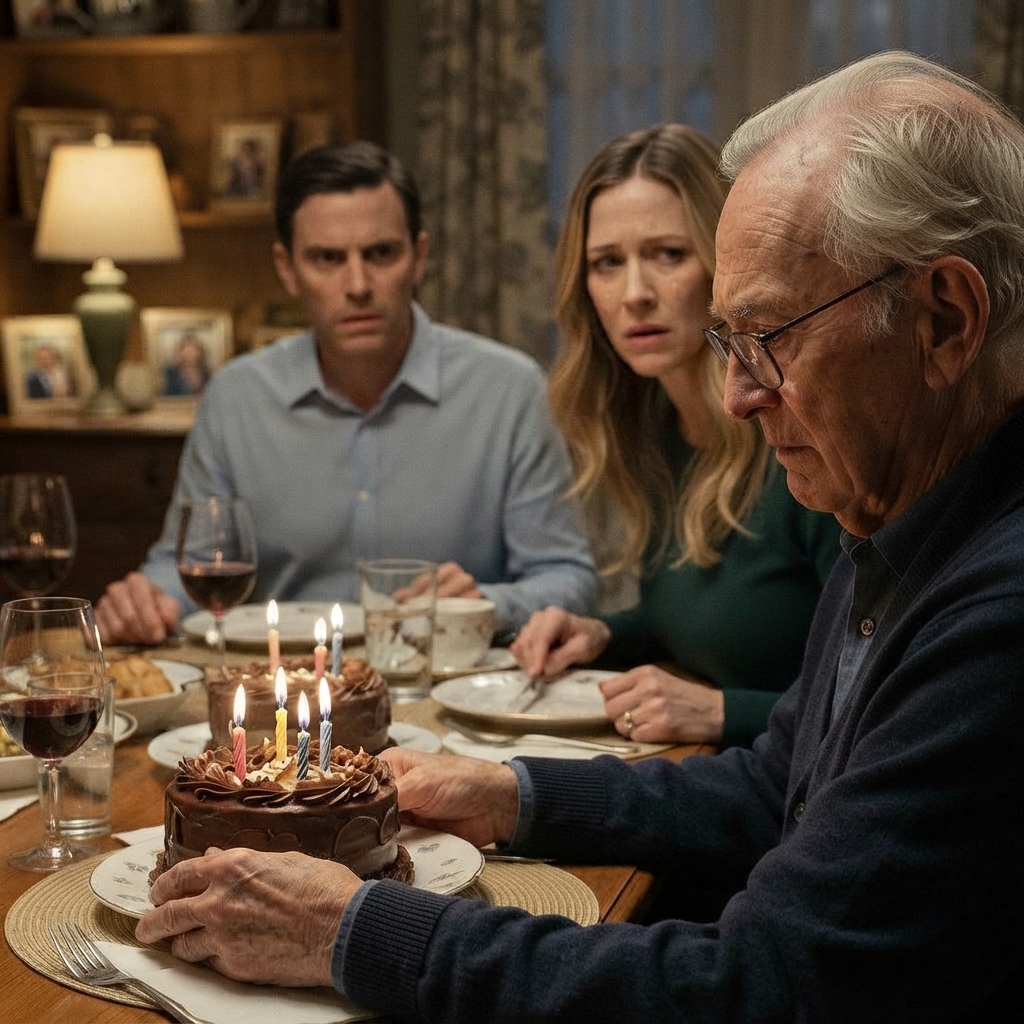
On my father’s next birthday, we didn’t have a fancy dinner.
No expensive decorations.
No business speeches.
Just family.
A homemade cake.
Simple food.
And two children sitting beside their grandfather with full plates.
My father kept Emma’s painted wooden bird on his desk.
He kept Lucas’s drawings too.
One afternoon, I saw him looking at them.
“What are you doing?”
He smiled.
“Remembering what matters.”
And for the first time in my life, I believed him.
Because sometimes the greatest family secrets aren’t about money.
They’re about the words people never say.
The apologies they delay.
The love they assume everyone already knows.
And sometimes one painful night at a birthday dinner is the moment a family finally decides to stop pretending.
The empty plates were never the thing that broke us.
The silence was.
And breaking that silence was what finally brought us back together.