The first thing I noticed was the silence.
Not the peaceful kind that comes with a calm lake at sunrise. This silence felt different. It was the kind that settles over a place when everyone is watching and waiting for something to happen.
I had just unlocked the front door of my grandfather’s old cedar cabin after driving six hours from the city. The porch still smelled like pine sap, the wind chimes my grandmother had hung twenty years earlier still swayed in the breeze, and the lake stretched out like polished glass beneath the morning sun.
For me, this wasn’t just a vacation house.
It was home.
My family had owned the property for nearly a century. My great-grandfather bought the original land in the 1930s when it was nothing more than forest, marshland, and an abandoned logging trail. Over the decades, neighboring parcels were sold, roads were built, and new lake houses appeared. Eventually an HOA formed for the newer subdivision across the water.
Our property had never been part of it.
That detail would become very important.
I had barely finished unloading my truck when I heard footsteps crunching across the gravel driveway.
A sharply dressed woman marched toward me carrying a clipboard like it was a badge.
“Excuse me,” she called before even saying hello. “Residents have reported suspicious activity.”
I smiled politely.
“I’m just opening up the cabin.”
“Whose cabin?”
“My family’s.”
She folded her arms.
“I’ve lived here eight years. I’ve never seen you.”
“I usually come during the fall.”
She didn’t look convinced.
“I’m the HOA president,” she announced proudly. “Everyone living around this lake registers with us.”
“I don’t.”
“Then you’re trespassing.”
I almost laughed.
“I’m definitely not.”
She looked past me toward the cabin.
“You have exactly ten minutes to leave before I call law enforcement.”
“I’m staying all week.”
Her expression hardened.
“We’ll see about that.”
She spun around and walked away.
I figured that would be the end of it.
I was wrong.
Less than twenty minutes later, two sheriff’s deputies pulled into the driveway with lights flashing.
Several neighbors wandered outside to watch.
The HOA president stood beside one patrol vehicle with an unmistakably satisfied smile.
One deputy approached.
“Afternoon, sir. We received a report of someone illegally occupying this cabin.”
“No problem,” I said. “I’m the owner.”
“Can I see some identification?”
I handed over my driver’s license.
He glanced at it.
Then at the cabin.
Then back at me.
“Do you have proof you own the property?”
“I have the deed in the house.”
While I retrieved the folder from the old desk inside, I could hear the HOA president talking loudly enough for everyone nearby to hear.
“I warned him.”
“People think they can just move into vacant homes.”
“It’s becoming a real problem.”
I returned with the documents.
The deputy studied them carefully.
His partner quietly radioed dispatch to verify the parcel number.
For nearly two minutes nobody spoke.
Finally the radio crackled.
The deputy’s eyebrows rose.
He read the response again.
Then he looked directly at the HOA president.
“Ma’am…”
“Yes?”
“Everything checks out.”
She blinked.
“What?”
“He owns this property.”
“That’s impossible.”
“No, ma’am.”
She pointed at me.
“I’ve never approved him.”
The deputy gave her a puzzled look.
“You don’t approve property ownership.”
“This neighborhood belongs to the association.”
He slowly shook his head.
“No, it doesn’t.”
Her confidence wavered for the first time.
“What do you mean?”
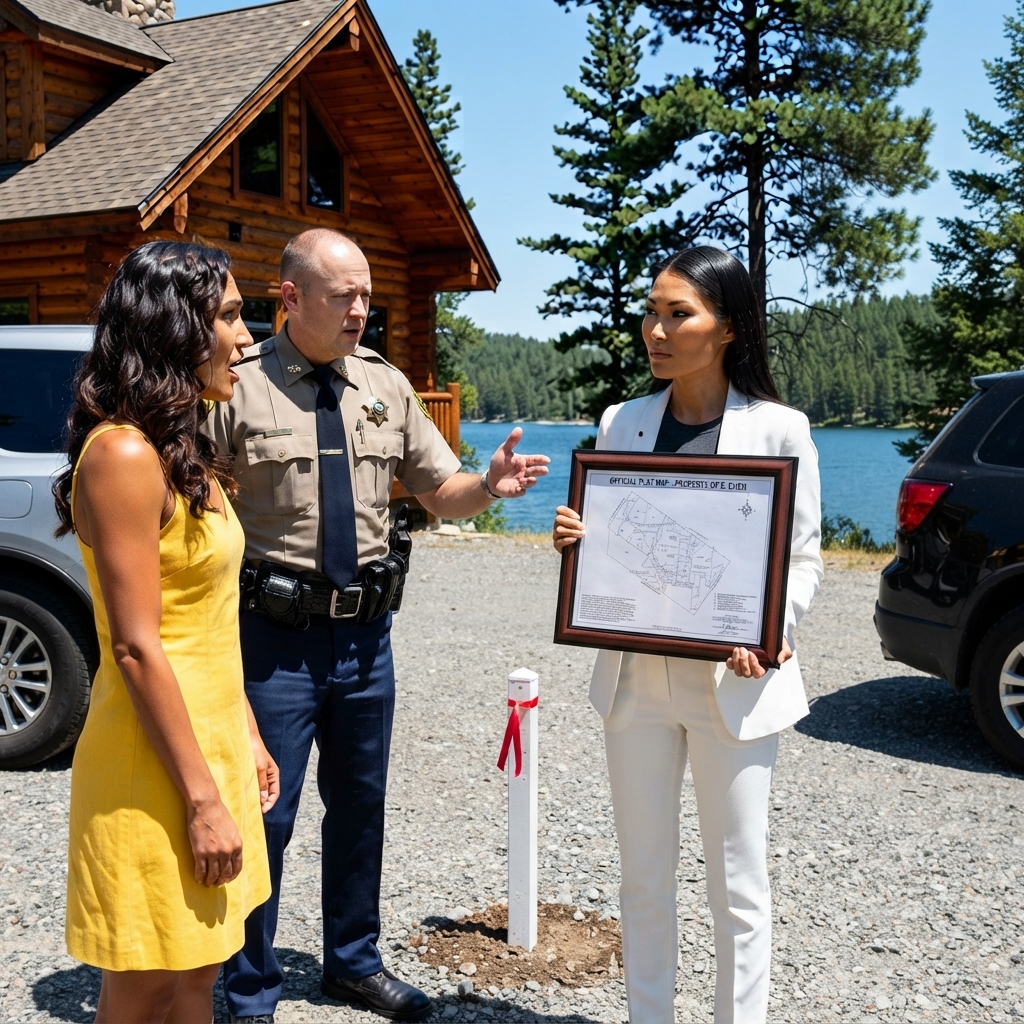
The deputy turned the paperwork toward her.
“This parcel predates your subdivision by decades.”
She stared at the survey map.
“Actually,” he continued, “it appears this isn’t just one parcel.”
I smiled.
“No.”
He flipped another page.
“It’s several.”
The deputy let out a low whistle.
“That’s… considerably more land than I expected.”
The map showed hundreds of wooded acres surrounding much of the northern shoreline.
Old logging roads.
Boat launches.
Forest.
Meadows.
Several unused cabins.
The deputy looked impressed.
“So your family still owns all this?”
“Yes.”
He pointed toward the road everyone had driven in on.
“Even the access road?”
“Yes.”
“And the old public dock?”
“It isn’t public.”
The HOA president looked like the ground had disappeared beneath her.
“What?”
“The dock belongs to us,” I explained. “We’ve simply always allowed people to use it.”
One neighbor whispered, “Seriously?”
Another nodded slowly.
“I always wondered why there wasn’t a county sign.”
The deputy asked dispatch one final question.
A moment later he laughed softly.
“Well…that answers it.”
“What now?” the HOA president demanded.
“The county confirms everything.”
She looked stunned.
“So…he owns…”
I finished her sentence.
“My cabin.”
“The shoreline.”
“The dock.”
“The woods.”
“The trails.”
“And most of the land surrounding your subdivision.”
Silence.
Then one elderly neighbor stepped forward.
“I remember your grandfather.”
I smiled.
“Harold?”
He nodded.
“He helped build half these homes.”
“My father did too.”
The old man laughed.
“I thought your last name sounded familiar.”
One by one, more longtime residents began recognizing stories they’d heard from parents and grandparents.
The family that donated land for the volunteer fire station.
The family that allowed emergency access through private roads.
The family that never closed hiking trails.
It had always been us.
We’d simply never made a point of advertising it.
The HOA president looked around as if waiting for someone to defend her.
Nobody did.
Instead, the sheriff himself arrived.
Apparently dispatch thought it was worth verifying the unusual property records in person.
He climbed out, looked at me for about two seconds, and smiled.
“I haven’t seen you since your father’s memorial.”
“It’s been a while.”
He shook my hand warmly.
“My condolences again.”
“Thank you.”
The HOA president interrupted.
“Sheriff, surely something can be done.”
He frowned.
“About what?”
“He’s violating HOA rules.”
The sheriff asked a simple question.
“Is his property part of your HOA?”
She hesitated.
“…No.”
“Then your rules don’t apply.”
“But—”
“This is a civil matter.”
“There isn’t even a civil issue,” I added.
“I’m simply staying at my own cabin.”
The sheriff nodded.
“Exactly.”
He turned toward everyone gathered.
“Folks, unless someone has an actual emergency, we’re finished here.”
The deputies returned to their vehicles.
Most of the neighbors drifted away.
Several stopped to introduce themselves.
One apologized for assuming the worst.
Another thanked my family for maintaining the old boat ramp over the years.
Before leaving, the sheriff looked back.
“If you need anything while you’re in town, let us know.”
“I appreciate it.”
After everyone left, the lake became quiet again.
I thought the drama was over.
It wasn’t.
The following afternoon there was another knock at my door.
This time it wasn’t the HOA president.
It was three neighbors carrying homemade pie.
“We wanted to apologize,” one woman said.
“We listened before we knew the facts.”
Another smiled.
“And we’d love to hear stories about what this place used to look like.”
We spent the next three hours on the porch looking through old photographs.
Children swimming from handmade docks.
Black-and-white pictures of the original logging camp.
My grandparents planting oak trees that now towered over the shoreline.
By sunset, strangers had become friends.
A week later, I received a handwritten letter.
It was from the HOA president.
She admitted she had acted too quickly, assumed authority she didn’t have, and allowed pride to cloud her judgment. She apologized for involving law enforcement without first checking the property records.
People can make mistakes.
Owning them takes more courage.
I accepted the apology.
Every autumn since then, I return to the same cabin.
The wind still moves through the pines.
The lake still reflects the morning sky.
And every time I walk down to the dock, I remember that real ownership isn’t about telling people they don’t belong.
It’s about taking care of a place so well that generations later, it still feels like home.