The ballroom sparkled beneath crystal chandeliers, every table decorated with white roses and golden candles. Guests laughed, glasses clinked, and a string quartet played softly in the corner. It was supposed to be the happiest day of Beatrice Holloway’s life.
She smiled for every photograph.
She thanked every guest.
She hugged every relative.
But beneath the elegant lace veil and perfectly styled chestnut wig was a secret she had carried for nearly a year.
Three months before the wedding, Beatrice had begun chemotherapy after doctors discovered an aggressive form of lymphoma. She had responded well to treatment, but she lost every strand of her hair. Only her closest family, her fiancé Daniel, and a handful of friends knew.
Daniel had insisted she wear—or not wear—whatever made her feel most like herself.
“You don’t owe anyone an explanation,” he’d told her.
So she chose the wig, hoping their wedding would be remembered for love rather than illness.
For most of the evening, everything went perfectly.
Then came the speeches.
Daniel’s father spoke first, followed by Beatrice’s maid of honor. Tears flowed. Laughter echoed across the room.
Finally, Daniel stood.
“I have one more surprise,” he announced.
He nodded toward the DJ, who lowered the music.
“I’ve watched the strongest person I’ve ever known fight every day this year. She planned this wedding between hospital visits. She smiled even when she felt awful. Tonight isn’t about pretending everything has been easy.”
Daniel looked directly at Beatrice.
“It’s about celebrating who you really are.”
He reached for her hand.
“If you’re ready.”
She understood immediately.
Her heart pounded.
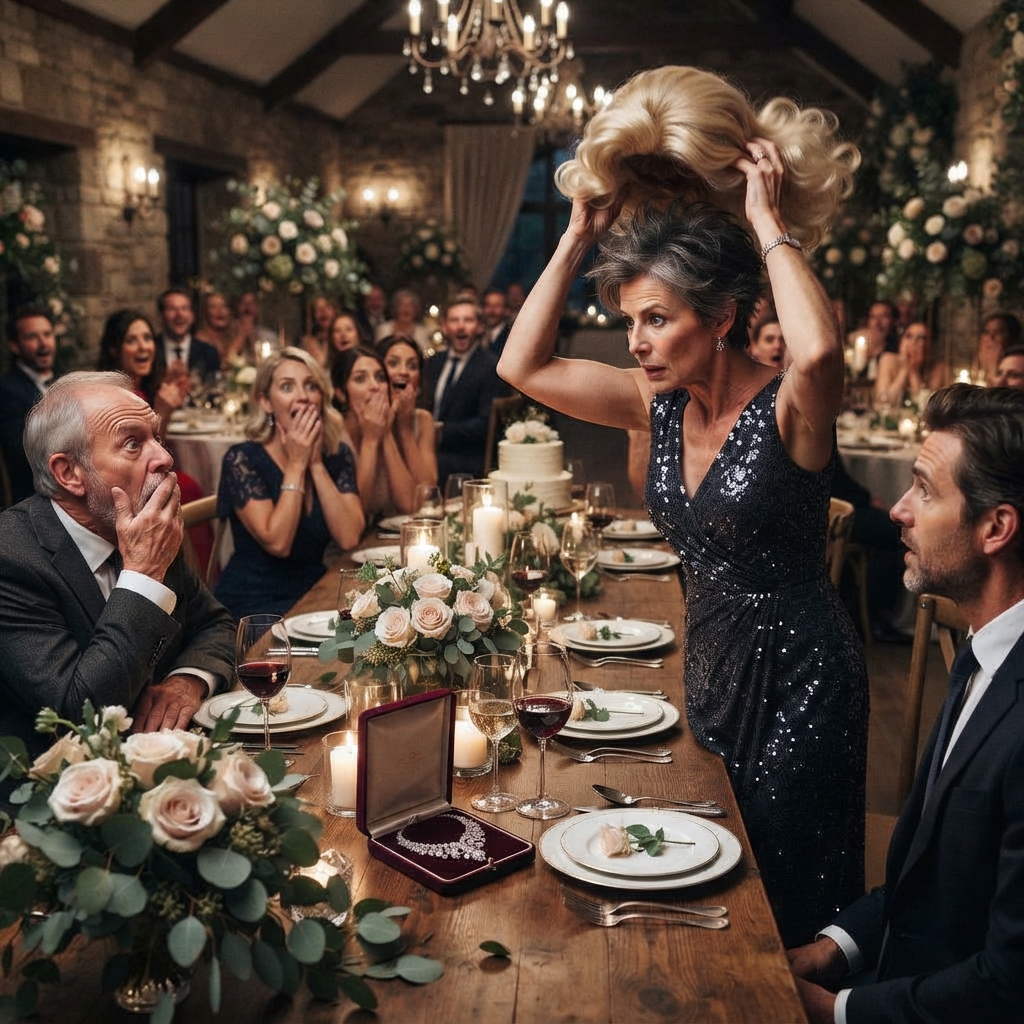
Slowly, she reached both hands to her head.
The room became silent.
One gentle movement.
The wig came away.
Her smooth scalp reflected the chandelier lights.
For a heartbeat, nobody moved.
Then Daniel kissed her forehead.
“I married the most beautiful woman in this room.”
The silence shattered into applause.
Guests stood.
Several wiped away tears.
Even people who hadn’t known her story began clapping.
But while everyone’s attention remained fixed on the newlyweds…
Someone slipped toward the gift table.
Twenty minutes later, panic spread through the ballroom.
“The silver keepsake box is gone!”
It wasn’t just any wedding gift.
Daniel’s late grandmother had left behind a handcrafted walnut box containing handwritten letters meant for each future grandchild on their wedding day. Inside Beatrice’s box was also a sapphire brooch that had belonged to Daniel’s great-grandmother.
The gift had vanished.
Staff searched everywhere.
Nothing.
The photographer checked his equipment.
Nothing.
Guests looked beneath tables.
Nothing.
An uncomfortable tension settled over the celebration.
Someone had taken it.
Security footage from the venue offered only partial answers.
The cameras covering the ballroom entrance briefly lost sight of the gift table during the applause after Beatrice removed her wig.
The distraction had lasted less than a minute.
Just enough time.
Police took statements.
Nobody wanted to believe a wedding guest could steal such a meaningful heirloom.
Three days later, Beatrice couldn’t stop thinking about one detail.
During the applause, she’d noticed her cousin Miranda quietly leaving the ballroom.
Miranda had always struggled financially, but Beatrice hated herself for even considering the possibility.
“There has to be another explanation,” she told Daniel.
Then Daniel remembered something else.
Miranda had insisted on helping organize the gift table before dinner.
She knew exactly which package contained the family heirloom.
Police interviewed everyone again.
Miranda denied everything.
Without evidence, the investigation stalled.
Weeks passed.
The newlyweds tried moving forward.
Until an unexpected phone call arrived.
A local antique dealer reported that a woman had tried selling a sapphire brooch matching the description released to nearby jewelers.
The dealer recognized it immediately.
Instead of buying it, he delayed the seller while calling authorities.
It was Miranda.
When questioned again, she finally confessed.
She hadn’t intended to steal from Beatrice specifically.
She admitted that when everyone stood to applaud after Beatrice removed her wig, she realized every eye in the room was focused elsewhere.
“It seemed like the perfect opportunity,” she whispered.
She planned to sell the brooch and discard the letters.
The officers recovered everything before she could.
Every letter.
Every photograph tucked inside.
Every family memory.
Nothing had been destroyed.
Months later, Beatrice finally opened the walnut box.
Daniel sat beside her.
Inside rested a folded letter addressed simply:
To the woman who joins our family.
With trembling hands, she unfolded the faded paper.
It read:
“Families are not measured by perfect days. They are measured by how they stand together during difficult ones. If you’re reading this, you’ve already become one of us.”
Beatrice couldn’t finish without crying.
Daniel wrapped his arm around her.
“I think Grandma would have loved you.”
She smiled.
“I hope so.”
“I know so.”
A year later, on their first anniversary, Beatrice returned to the same ballroom.
This time, she wore no wig.
Her short curls had just begun growing back.
The venue manager recognized her instantly.
“You look wonderful.”
“Thank you.”
She smiled.
“So does life.”
The missing gift had been found.
The thief had faced justice.
The family letters had been saved.
But the greatest gift from that wedding wasn’t hidden inside a walnut box.
It was the moment Beatrice stopped hiding who she was.
The applause she received that night had never really been for taking off a wig.
It was for having the courage to show the world her true self.
And from that moment on, she never covered her head again.
Part 2: The Letter No One Was Supposed to Read
One week after their first anniversary, Beatrice believed the hardest chapter of her life was finally behind her.
Her health had improved.
Her hair had grown into soft, dark curls.
The stolen wedding gift had been recovered.
And Miranda, after pleading guilty to theft, had begun serving a reduced sentence after agreeing to restitution and counseling.
Life felt… ordinary.
For the first time in years, ordinary felt extraordinary.
Then the phone rang.
Daniel answered.
“It’s for you,” he said, his expression puzzled. “It’s Mr. Aldridge.”
Beatrice immediately recognized the name.
Harold Aldridge had been the family attorney for more than forty years. He had handled Daniel’s grandparents’ estate and knew every branch of the Holloway family tree.
“I wasn’t expecting your call.”
“I’ve found something,” the elderly lawyer said quietly.
“What kind of something?”
“A letter.”
Beatrice frowned.
“I thought all of your grandmother’s letters were recovered.”
“So did I.”
The next afternoon, Beatrice and Daniel sat across from Mr. Aldridge in his office.
The lawyer placed an old cream-colored envelope on his desk.
Its edges had yellowed with age.
Across the front, in elegant handwriting, were four words.
To Be Opened Last.
“It was hidden inside a false compartment in your grandmother’s writing desk,” Mr. Aldridge explained. “The furniture was donated to the historical society after the estate was settled. During restoration, they found this.”
Daniel carefully turned the envelope over.
The wax seal was still intact.
“This wasn’t mentioned in Grandma’s will.”
“No,” Mr. Aldridge replied. “Because she wrote it after the will.”
Beatrice looked at Daniel.
“You should open it.”
He shook his head.
“No.”
“You.”
With trembling fingers, she broke the seal.
Inside was a single handwritten letter.
If this letter reaches you, it means you’ve already weathered at least one storm together.
That makes you ready for the truth.
Beatrice exchanged a nervous glance with Daniel.
She continued reading.
The sapphire brooch was never the family’s greatest treasure.
It was only the key.
Daniel leaned forward.
“The key?”
Mr. Aldridge looked just as confused.
Beatrice kept reading.
Inside the walnut box is a hidden compartment. I prayed no one would ever find it through greed.
Her heart raced.
“We searched that box,” Daniel whispered.
“Not completely.”
That evening, they placed the walnut keepsake box on their kitchen table.
The same table where it had rested after being recovered from the police.
Daniel inspected every inch.
Nothing.
Then Beatrice noticed something unusual.
One corner of the velvet lining looked slightly raised.
She pressed gently.
Click.
A tiny wooden panel slid open.
Both of them froze.
Inside lay a small brass key.
And another envelope.
This envelope contained no jewelry.
No money.
Only a faded photograph.
The picture showed Daniel’s grandmother standing beside an unfamiliar young woman outside a tiny brick building.
On the back, someone had written:
“Promise fulfilled. 1978.”
There was also a bank deposit box number.
Neither Daniel nor Beatrice had ever heard of it.
The following morning, they visited the local bank.
The manager confirmed the deposit box still existed.
“According to our records,” she said, “access requires this original key and identification.”
Minutes later, the heavy metal drawer slid onto a private viewing table.
Inside sat a leather journal.
A stack of letters.
A small velvet pouch.
And one sealed envelope addressed to Daniel.
He opened it carefully.
Inside, his grandmother’s handwriting greeted him one final time.
Families sometimes inherit more than homes and jewelry.
Sometimes they inherit responsibilities.
The journal explained everything.
In the late 1970s, Daniel’s grandmother had secretly funded a shelter for women escaping domestic violence.
She had sold several valuable family heirlooms without telling anyone.
The Holloway family, proud of its wealth and reputation, would never have approved.
To keep the shelter alive, she had quietly invested what remained.
Year after year.
Decade after decade.
The investments had grown.
Far beyond anything she imagined.
Mr. Aldridge nearly dropped his glasses when he reviewed the documents.
“The trust…”
He looked at Daniel in disbelief.
“…is worth nearly four million dollars.”
Silence filled the office.
“But,” the attorney continued, “there’s a condition.”
Daniel smiled.
“There’s always a condition.”
Mr. Aldridge nodded.
“The money cannot be inherited personally.”
“What does that mean?”
“It belongs to the charitable foundation.”
Beatrice let out a relieved laugh.
“So Grandma wasn’t hiding a fortune for us.”
“No.”
“She was hiding hope for someone else.”
Over the next six months, Beatrice and Daniel worked with attorneys, accountants, and community leaders.
The forgotten foundation was rebuilt.
The old shelter was renovated.
A new counseling center opened.
Scholarships were created for survivors rebuilding their lives.
The first plaque inside the entrance carried only a single sentence:
“Strength shared becomes hope multiplied.”
No family name.
No recognition.
Just the words Daniel’s grandmother would have wanted.
On opening day, a familiar voice stopped Beatrice in the hallway.
“I wasn’t sure you’d want to see me.”
She turned.
Miranda stood nervously near the entrance.
She had recently been released and was completing a community rehabilitation program.
“I heard about the shelter,” Miranda said softly.
“I wanted to apologize again.”
Beatrice remained quiet.
“I know I can’t undo what I did.”
“No,” Beatrice replied.
“You can’t.”
Miranda lowered her eyes.
“But maybe,” Beatrice continued, “people aren’t only defined by their worst decision.”
Tears filled Miranda’s eyes.
“I’d like to volunteer here.”
Beatrice looked toward Daniel.
He gave a small nod.
“You’ll have to earn everyone’s trust.”
“I know.”
“And it won’t happen overnight.”
“I understand.”
For the first time since the wedding, the two cousins embraced.
Not because the past had disappeared.
But because forgiveness had finally found a place to begin.
As the doors of the shelter opened to welcome its first families, Beatrice glanced at the plaque in the lobby and thought about the missing wedding gift that had nearly been lost forever.
In the end, the sapphire brooch wasn’t the true inheritance.
Neither was the hidden trust.
The real legacy was the courage to protect others, to choose compassion over pride, and to believe that even after betrayal, broken relationships could begin to heal.
Sometimes the greatest gifts are the ones that lead us to a purpose we never expected.