The first photo I took after my daughter woke up wasn’t a happy one.
She was pale.
There were dark circles beneath her eyes, a breathing tube taped to her cheek, and enough wires attached to her tiny body to make my stomach twist every time I looked at her.
But she was alive.
After twelve hours in surgery, three blood transfusions, and a surgeon quietly telling me, “We almost lost her twice,” she squeezed my finger.
That tiny squeeze felt like a miracle.
I snapped a picture.
Not because I wanted sympathy.
Because I thought family would want to know she had made it.
I sent it to our family group chat.
Me: “She made it through surgery. She’s asking if Grandma and Uncle Ryan can come see her when she’s awake.”
The typing bubble appeared almost immediately.
Ryan, my older brother.
Ryan: “Busy. Handle it.”
Just two words.
Busy.
Handle it.
Before I could even process them, another message appeared.
From Mom.
Mom: “She lived. Stop making her our problem.”
I stared at the screen.
My hands started shaking.
Our problem?
This little girl used to spend every Saturday baking cookies with Grandma.
Ryan had once called himself “the coolest uncle in town.”
Now they couldn’t spare fifteen minutes?
I didn’t answer.
I simply typed,
“It’s okay.”
Then I locked my phone.
The moment the screen went black, I buried my face in the hospital blanket and cried harder than I had all week.
The nurse found me fifteen minutes later.
She didn’t ask questions.
She simply handed me tissues and whispered,
“They’re missing out.”
I nodded.
I wasn’t ready to admit she was right.
Emma opened her eyes the next afternoon.
“Daddy?”
“I’m here.”
“Did Grandma come?”
I swallowed.
“Not yet.”
“Oh.”
Just one tiny word.
But it broke something inside me.
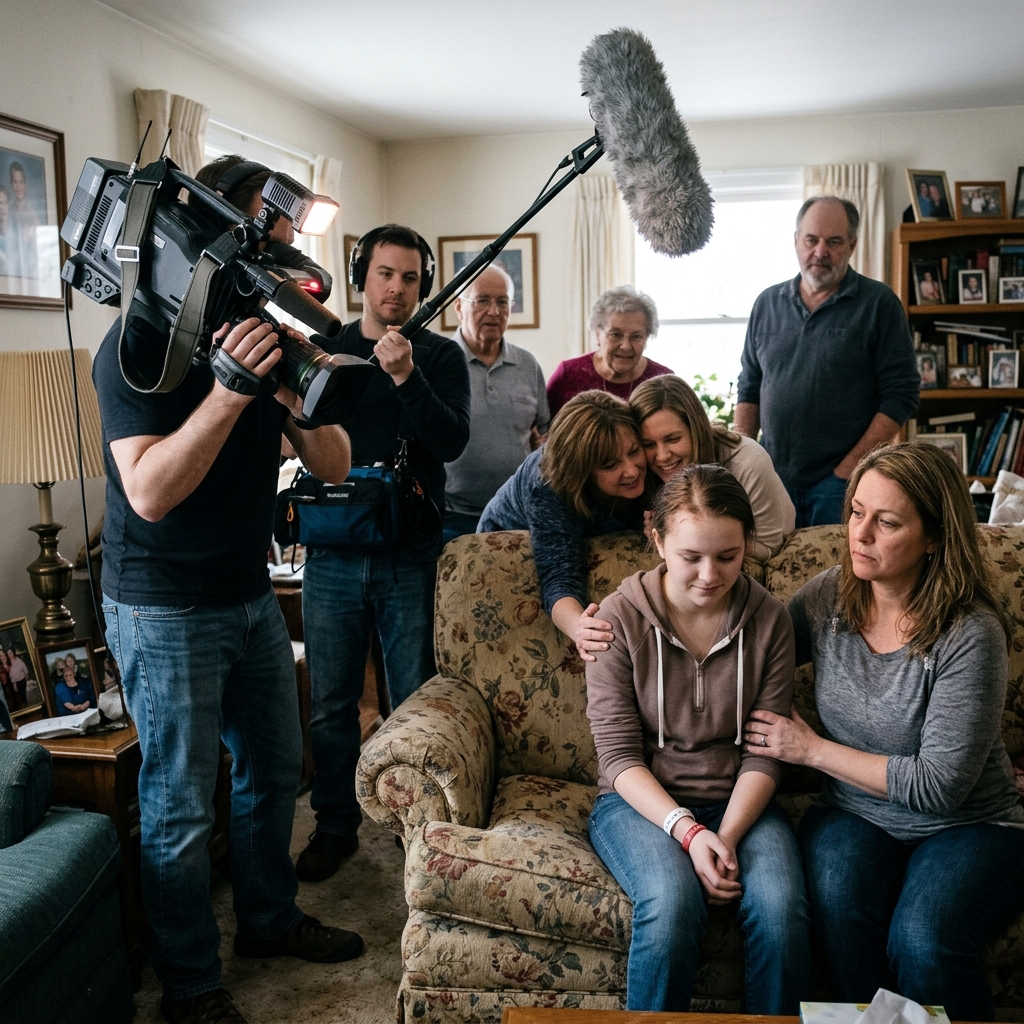
Three days later, a woman knocked gently on our hospital room door.
She wore jeans, carried a camera bag, and introduced herself.
“I’m Lisa with Channel Seven.”
I frowned.
“I think you have the wrong room.”
“No.”
She smiled.
“The hospital nominated your daughter for our weekly Courage Kid segment.”
Apparently one of the nurses had submitted Emma’s story.
Rare heart condition.
Emergency surgery.
Months of treatments.
Her endless habit of thanking every nurse before bedtime.
Lisa asked if we’d be comfortable filming.
Emma’s eyes lit up.
“Will Grandma see me?”
I forced a smile.
“Maybe.”
The camera crew spent an hour with us.
They interviewed surgeons.
Nurses.
Physical therapists.
Then they asked me one question.
“What kept you going?”
I looked at Emma.
“She did.”
Nothing more.
Nothing dramatic.
Just the truth.
The segment aired Friday at ten.
I didn’t even watch it live.
Emma had finally fallen asleep, and I was sitting beside her bed eating vending-machine crackers.
My phone exploded.
Calls.
Texts.
Voicemails.
Ryan.
Mom.
My aunt.
Cousins I hadn’t heard from in years.
I ignored every one.
Finally I answered my aunt.
“What happened?”
She sounded breathless.
“You haven’t seen the news?”
“No.”
“They called your daughter the bravest kid in the city.”
Later that night I watched the replay.
The reporter stood outside the children’s hospital.
Then the story began.
There was Emma, smiling weakly from her hospital bed.
Talking about how nurses were superheroes.
Then one clip caught me completely off guard.
The interviewer asked,
“Who’s been with you every day?”
Emma smiled.
“My daddy.”
“What about the rest of your family?”
She hesitated.
Then answered honestly.
“They’re busy.”
No anger.
No bitterness.
Just honesty.
The room fell silent.
Even the reporter looked emotional.
By morning, the clip had millions of views.
People weren’t talking about the surgery.
They were talking about that answer.
“They’re busy.”
Two words.
Children don’t know how to lie politely.
Ryan called seventeen times.
Mom came to the hospital without warning.
She arrived carrying balloons.
Flowers.
Stuffed animals.
Chocolate.
The biggest apology money could buy.
She burst into tears the moment she saw Emma.
“Oh sweetheart…”
Emma smiled politely.
“Hi, Grandma.”
Mom reached for me.
“I’m so sorry.”
I looked at her.
“For what?”
“I didn’t realize…”
I waited.
She couldn’t finish.
Didn’t realize what?
That a child nearly died?
That words leave scars?
Or that strangers had witnessed what she wanted hidden?
Ryan showed up an hour later.
“I messed up.”
“You did.”
“I was stressed.”
“So was I.”
“I didn’t know it was that serious.”
I stared at him.
“She was in life-saving surgery.”
He looked at the floor.
There wasn’t another excuse left.
Over the next few weeks, everyone suddenly wanted to help.
Meals arrived.
Offers to babysit.
Birthday gifts.
Vacation invitations.
Family photos.
It all looked wonderful.
From the outside.
But trust isn’t rebuilt with flowers.
It’s rebuilt with consistency.
Emma eventually recovered.
Slowly.
Painfully.
One determined step at a time.
She went back to school six months later.
She still has a scar running down the center of her chest.
Sometimes she traces it with one finger.
“My superhero line,” she calls it.
I like that better than “scar.”
Mom still apologizes.
Ryan still tries.
Sometimes people really do change.
Sometimes public shame forces them to see what private pain never could.
I hope their change is genuine.
For Emma’s sake.
But I also learned something that hospital room taught me.
Family isn’t defined by a group chat.
It’s defined by who shows up when the monitors are beeping, the coffee is cold, the future is uncertain, and a frightened little girl asks, “Did Grandma come?”
The cameras didn’t reveal who loved my daughter.
They revealed who had already chosen not to.
And once the lights were off, the only people who truly mattered were the ones who had been there long before anyone started watching.
Part 2: The Visit That Changed Everything
The hospital discharged Emma on a rainy Tuesday morning.
She insisted on walking out instead of riding in the wheelchair.
“I can do it,” she said, gripping my hand with surprising determination.
The nurse smiled.
“Hospital rules say we have to offer the wheelchair.”
Emma looked up at me.
“Can I at least walk to it?”
The nurse laughed. “Deal.”
It took us nearly ten minutes to reach the front entrance.
Every few steps she stopped to catch her breath, but she refused to complain.
When we finally reached the car, several nurses stood under the awning, waving goodbye.
One of them called out, “Keep being our superhero, Emma!”
She saluted them with the biggest grin I’d seen in weeks.
For the first time since the surgery, I believed we were going to be okay.
Home felt different.
The living room had become a temporary recovery room.
A recliner replaced the couch.
Medication schedules covered the refrigerator.
A plastic organizer held pills, bandages, and appointment cards.
Emma walked in slowly, looking around.
“It smells like home.”
“It is home.”
She hugged me carefully, avoiding the scar on her chest.
“I missed it.”
“So did I.”
That first night she slept in her own bed for the first time in nearly a month.
I didn’t.
I sat in a chair beside her until sunrise, waking every time she shifted beneath the blankets.
Old habits are hard to break.
Especially when you’ve spent weeks wondering if your child would survive the night.
The next afternoon, there was a knock at the door.
Not a gentle one.
Three sharp knocks.
I already knew who it was.
Mom stood on the porch holding a casserole dish wrapped in aluminum foil.
Ryan stood behind her with grocery bags.
Neither of them smiled.
“Can we come in?” Mom asked quietly.
Emma peeked around the corner.
“Grandma!”
Her face lit up.
Children forgive so much faster than adults.
Mom’s eyes immediately filled with tears.
She knelt carefully and opened her arms.
Emma hugged her without hesitation.
“I missed you.”
“I missed you too,” Mom whispered.
I wanted to believe her.
I really did.
Ryan awkwardly set the grocery bags on the kitchen counter.
“I bought some things.”
I looked inside.
Milk.
Bread.
Fruit.
Juice boxes.
Frozen meals.
The practical things.
Not expensive gifts.
Just groceries.
He rubbed the back of his neck.
“I figured cooking is probably the last thing you want to think about.”
It wasn’t much.
But it was the first thoughtful thing he’d done in a long time.
“Thanks,” I said.
He nodded, almost surprised I’d accepted.
Dinner was painfully quiet.
Emma filled every silence with stories from the hospital.
“The nurse let me decorate my IV pole.”
“I beat Daddy at checkers.”
“I got three stickers because I took my medicine.”
Mom laughed.
Ryan smiled.
For a few minutes, it almost felt like we were a family again.
Then Emma asked the question no one expected.
“Grandma?”
“Yes, sweetheart?”
“Why didn’t you come to see me?”
The room froze.
Even the clock on the wall suddenly sounded loud.
Tick.
Tick.
Tick.
Mom’s fork stopped halfway to her mouth.
She looked at me.
Then back at Emma.
“I…”
She couldn’t find the words.
Emma wasn’t accusing her.
She was simply asking.
Children ask questions adults spend years avoiding.
Finally, Mom whispered, “I was wrong.”
Emma tilted her head.
“Wrong how?”
Mom wiped her eyes.
“I thought… I thought your dad had everything under control.”
Emma frowned.
“But I wanted you.”
No one spoke.
Not because there was nothing to say.
Because there was nothing that could undo that sentence.
Ryan stood up and walked to the sink.
He stared out the kitchen window for a long moment before speaking.
“When Dad died,” he said quietly, “I decided the easiest way to deal with hard things was to stay away from them.”
I looked at him.
He kept facing the window.
“I skipped hospital visits.”
“I ignored bad news.”
“I convinced myself people needed space.”
He laughed bitterly.
“Truth is… I was the one creating the space.”
Mom looked shocked.
“I didn’t know you felt that way.”
“I never told anyone.”
Emma slid off her chair and walked over to him.
Her steps were slow and careful.
She tugged gently on his sleeve.
“It’s okay to be scared.”
Ryan turned around.
“What?”
“I was scared too.”
She pointed at the scar on her chest.
“But Daddy stayed.”
Those three words landed harder than any accusation ever could.
After dinner, Ryan asked if he could help clean up.
We stood shoulder to shoulder washing dishes.
Neither of us spoke for several minutes.
Finally, he broke the silence.
“I don’t expect you to forgive me.”
“I don’t.”
“I deserve that.”
I rinsed another plate.
“You don’t need to convince me you’re sorry.”
He nodded.
“You need to convince her you’ll be there next time.”
He looked toward the living room, where Emma was teaching Grandma how to play a card game she’d learned from one of the nurses.
“I will.”
“I hope so.”
Because there will always be a next time.
Maybe not another surgery.
Maybe not another hospital.
But life has a way of testing promises.
Over the next few weeks, Ryan kept showing up.
Every Saturday morning.
No announcement.
No social media posts.
He’d bring pancakes from the diner down the street or a puzzle for Emma to work on.
Sometimes they’d build LEGO sets.
Sometimes they’d just watch cartoons.
He never acted like he was making up for anything.
He simply came.
Again.
And again.
Consistency doesn’t erase the past.
But it does begin to write a different future.
One quiet visit at a time.
Still, I couldn’t shake the feeling that the hardest conversation was yet to come.
Because while Ryan was trying to rebuild trust…
Someone else had decided the television story had made our family “look bad.”
And they were about to demand that I fix it.