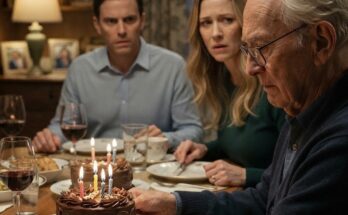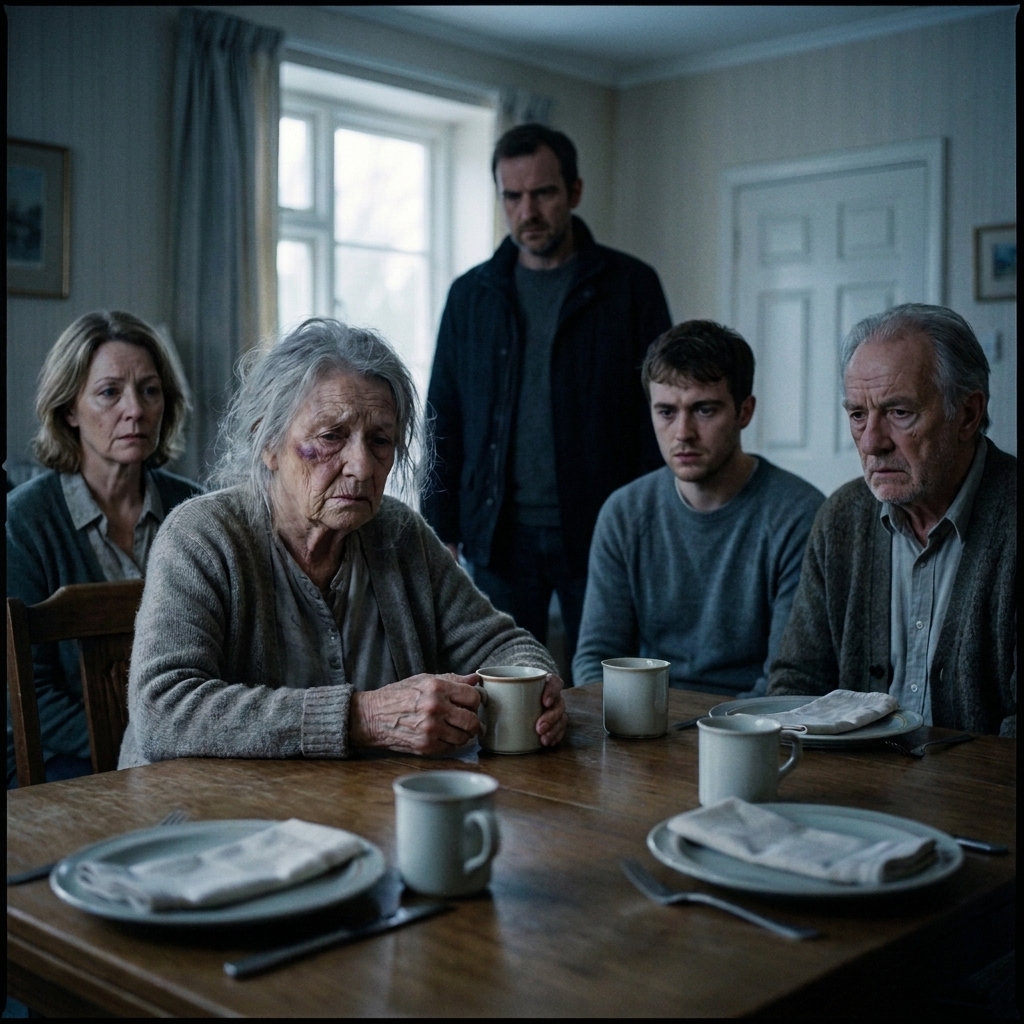
The slap wasn’t hard enough to leave a bruise.
It was hard enough to leave a silence.
My seventeen-year-old son, Ethan, stood frozen the instant his hand connected with my cheek. His eyes widened as though someone else had done it. For a heartbeat, neither of us moved.
Then he grabbed his backpack and stormed out of the house, slamming the front door so violently that a picture frame crashed onto the hallway floor.
I didn’t cry.
Not then.
I simply bent down, picked up the broken glass, and wondered where I’d lost my little boy.
People imagine violence arriving with warning signs—raised voices, broken furniture, threats shouted across the room.
Sometimes it arrives after months of exhaustion.
I’d been working two jobs since my husband died ten years earlier. Ethan had changed during the past year. He was angry at everything. School. Curfews. Chores. Me.
Every conversation became a battle.
Every request sounded, to him, like criticism.
That night, I’d taken away his car keys after learning he’d skipped school for the third time.
He called me controlling.
I called him irresponsible.
He stepped closer.
I refused to back down.
Then his hand came up.
The moment lasted less than a second.
Its echo lasted all night.
I barely slept.
Instead, I stared at old family photo albums until sunrise.
There was Ethan at five, proudly showing me a crooked drawing.
Ethan at eight, missing his front teeth.
Ethan at twelve, crying at his father’s grave because he thought no one could hear him.
Grief changes children in ways adults often mistake for rebellion.
But grief isn’t permission to hurt people.
By six in the morning, I’d made a decision.
Not about punishment.
About truth.
I cooked breakfast exactly as I had every Sunday for years.
Pancakes.
Eggs.
Fresh fruit.
Orange juice.
Then I set the table.
One plate for me.
One for Ethan.
One for my younger daughter, Lily.
And then…
A fourth place.
A fourth plate.
A fourth glass.
A neatly folded napkin.
No one who lived in our house would sit there.
Lily walked into the kitchen first.
She frowned immediately.
“Mom… are we expecting company?”
“No.”
She looked around again.
“Then why four places?”
“You’ll see.”
She didn’t ask another question.
Ethan came downstairs nearly an hour later.
His eyes were red.
Whether from crying or lack of sleep, I couldn’t tell.
He stopped the second he saw the table.
“What is this?”
“Breakfast.”
“Who’s coming?”
I gestured toward the empty chair.
“Sit down.”
He hesitated before taking his seat.
His gaze kept returning to the fourth place.
Finally he asked, “Seriously… who’s that for?”
I looked directly into his eyes.
“For someone who should have been part of this family years ago.”
He frowned.
“I don’t understand.”
“I know.”
I stood and walked to the kitchen drawer.
From it, I pulled a faded envelope I’d carried around for nearly fifteen years.
I placed it beside the empty plate.
“I’ve never shown you this.”
He looked confused.
“What is it?”
“A letter your father wrote before he died.”
His face changed instantly.
“You told us there weren’t any.”
“I lied.”
Silence.
“I wasn’t ready.”
His father had been sick for months before cancer finally won.
During those final weeks, he’d written several letters.
One for me.
One for Lily.
One for Ethan.
And one addressed to someone simply called “My Brother.”
I had delivered the first three.
The fourth had remained hidden.
Not because I wanted to keep a secret forever.
Because I didn’t know where to find the man.
Your father had become estranged from his older brother nearly twenty years before I met him.
Neither would talk about why.
When my husband died, I searched for his brother for months.
Nothing.
Eventually life demanded all my attention.
The letter stayed in that drawer.
Unread.
Undelivered.
Last month, everything changed.
A woman contacted me through social media.
She was researching our family tree.
During our conversation she casually mentioned my late husband’s brother.
Alive.
Living three states away.
Married.
Two grown daughters.
He’d spent years believing his younger brother wanted nothing to do with him.
Neither man had known the other had tried to reconnect.
Pride had stolen decades.
Death had stolen the chance to fix it.
I finally found him.
His name was Daniel.
He cried when I called.
Ethan stared at me.
“You found Uncle Daniel?”
I nodded.
“He’ll be here this afternoon.”
His mouth fell open.
“I set four places because I wanted you to see something before he arrives.”
He looked from the empty chair to me.
“I don’t get it.”
I took a slow breath.
“Families don’t usually fall apart all at once.”
“They separate one painful moment at a time.”
“One angry word.”
“One slammed door.”
“One year without making a phone call.”
“One hand raised in anger.”
The room became painfully still.
I continued.
“Your father spent years wishing he’d repaired things with his brother.”
“He never got another chance.”
I looked at Ethan.
“But you do.”
His shoulders began shaking.
“I’m sorry.”
I said nothing.
“I don’t know why I did it.”
Still I waited.
“I wanted to hurt someone because everything hurts inside.”
His voice cracked.
“But the second I hit you…”
He buried his face in his hands.
“I hated myself.”
He stood.
Walked around the table.
Dropped to his knees beside my chair.
He hadn’t done that since he was a little boy after accidentally breaking my favorite vase.
“I’m so sorry, Mom.”
“I know saying it isn’t enough.”
“I know.”
“I’ll do whatever it takes.”
For the first time since the night before, I let myself cry.
Not because he’d struck me.
Because the boy I’d feared I’d lost was finally speaking again.
I wrapped my arms around him.
Forgiveness wasn’t immediate.
Trust wouldn’t magically return overnight.
But healing had begun.
That afternoon, the doorbell rang.
Daniel stood outside holding a worn leather bag.
The resemblance to my husband stole my breath.
The same smile.
The same eyes.
Only older.
When Ethan opened the door, Daniel smiled uncertainly.
“You must be my nephew.”
Ethan didn’t answer.
He stepped forward and hugged him.
Hard.
Daniel hugged him back without asking why the teenager was crying.
Sometimes love recognizes pain before names are exchanged.
We finally sat down together.
This time, all four places at the table were filled.
Daniel read the letter his brother had written years earlier.
By the end, none of us had dry eyes.
It wasn’t about regret.
It was about hope.
My husband had written:
“If you’re reading this, it means someone finally found you. Don’t waste another day being strangers to the people you love.”
Those words reached Daniel too late.
But they reached Ethan exactly when he needed them.
Months passed.
Ethan kept every promise he made that morning.
He attended counseling.
He took responsibility for his actions without making excuses.
He worked to earn back my trust, one ordinary day at a time.
Some days were awkward.
Some were difficult.
But none of them involved another raised hand.
Daniel became a regular part of our lives.
Sunday breakfasts slowly became our tradition.
Four places.
Four stories.
Four people choosing each week to stay connected.
Now, whenever someone notices the old photograph hanging above our dining table and asks why there are always four matching chairs, I simply smile.
Because they aren’t just chairs.
They’re reminders.
Families aren’t held together by perfect people.
They’re held together by people who choose, again and again, to put down their pride, pull up a chair, and stay long enough to heal.